
Welding has become an integral part of the aerospace, mechanical engineering, construction and home repair industries. A wide variety of methods are used to join metals and their alloys. A special place among them should be given to the inexpensive but very effective method of TIG welding.
In this article we will give an overview of working methods, technologies and metals that can be welded by this method.
We will pay special attention to the equipment, tools and consumables, as well as the principles of working in a protective atmosphere.
The peculiarity of this method is the use of argon as an inert gas. It is heavier than helium and forms a gas cushion at the welding site, which completely displaces oxygen and other impurities. This allows for high quality welds and reliable adhesion.
TIG welding has many advantages, including
- High quality welds;
- The ability to control the welding process and the state of the arc;
- No metal spatter in different directions during operation;
- The welding process can be performed in any position;
- No slag, no harmful emissions that can enter the equipment and cause the machine to break.
This method can also be used to weld very thin, delicate layers of metal, the only drawback is that the welding process is much slower than welding metal with other equipment.
What do you need to start TIG welding?
- A special torch equipped with a ceramic nozzle with a conductive collet inside to hold a tungsten electrode and a handle with a bayonet connector to connect to a welding machine and an inert gas cylinder;
- A hose package consisting of a power cord and an inert gas hose;
- Argon or helium cylinder (two cylinders if a mixture of these gases is required).
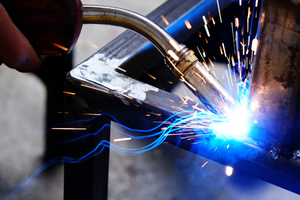
The electrode protrudes only a few millimeters from the nozzle and its main part is placed in a long cap (hood). There is a button on the torch handle which, when pressed, supplies current to the electrode to create a welding arc and gas to the torch nozzle, protecting the welding zone from atmospheric air.
For welding, it is necessary to use filler wire or rod made of the same metal as the parts to be welded. In case of tight fit and small thickness of the parts to be welded, the wire may not be necessary. It will be sufficient to melt the tangents. In other cases, the argon welder feeds the rod with one hand and holds the torch with the other.
The most popular equipment for TIG welding today is an inverter-type argon welding machine based on an IGBT element. It is superior to transformers and rectifiers in all performance indicators. Today you can buy various types of inverters for argon welding with different functions, including
- professional, semi-professional or home use;
- direct current (DC) or universal (AC / DC), using both direct and alternating current for welding, which allows the welding of workpieces made of aluminum and its alloys;
- with or without pulsed mode for linear welding of thin sheets;
- with water, forced air and forced air intelligent cooling.
We have tried to provide as much detail as possible about welding and its application when working with different metals and in direct and alternating current modes. This method is expensive and requires certain qualifications, but once you master it, you will have a universal way to join a wide variety of parts and the ability to repair metal products of different thicknesses.